
Unifying Healthcare Camp Planning and Execution
The Operating Context
Healthcare camps depend on work happening across locations, teams and time-sensitive schedules. A camp request may begin with a client or field representative, but its execution involves operations teams, coordinators, phlebotomists, technicians, sourcing teams, training teams, KYC teams, asset teams and finance.
For a digital healthcare partner, the requirement was to bring these moving parts into one structured environment.
The need was not only to digitise camp requests. The larger requirement was to create a dependable operating layer where people, resources, approvals, communication and reporting could move together with better visibility.
The Need Behind The Build
The healthcare partner needed a platform that could reduce scattered coordination and support a more standardised process for managing healthcare camps.
The existing operating model involved several connected activities:
- Client onboarding and camp registration
- Full-time and on-demand camp requests
- Phlebotomist, technician and healthcare worker sourcing
- Training and assessment workflows
- KYC and document verification
- Camp allocation and field-team coordination
- Inventory and device allocation
- Live camp status updates
- Reimbursement and issue requests
- Client approvals and finance reporting
Each of these activities involved different teams and decision points. Racer Tracker was built to bring them into a clearer digital workflow, while keeping role-based access and operational control in place.
The Solution in Focus
SumCircle developed Racer Tracker as a custom healthcare camp management platform for planning, coordinating and monitoring camp operations.
The platform was designed around the complete camp lifecycle, from client onboarding and camp request creation to field assignment, live execution, inventory updates, approval flows and reporting.
It gave different users access to the information and actions relevant to their role. Admin teams could manage master data and workflows. Operations teams could assign resources and monitor progress. Field users could accept or reject camp assignments, update status and raise requests. Clients and authorised representatives could view camp status, history and reports.
The result was a connected healthcare operations platform rather than a standalone scheduling tool.
What Racer Tracker Enabled
Centralised Camp Operations
Racer Tracker brought camp schedules, client details, field assignments, inventory status, invoices, reports and camp history into one operating environment.
Role-Based Access
Different users, including admin teams, operations teams, coordinators, sourcing teams, KYC teams, healthcare workers, finance teams and clients, could access workflows relevant to their responsibilities.
Full-Time and On-Demand Camp Management
The platform supported both planned and on-demand camp requirements, helping teams manage requests, resource availability and camp allocation more consistently.
Field-Team Coordination
Phlebotomists, technicians and other healthcare workers could receive camp notifications, accept or reject assignments, view camp details and update execution status.
Live Location and Camp Visibility
Google/Bing Maps and live location tracking supported camp location visibility, assigned resource movement and current camp status monitoring.
Training and Assessment Support
The system supported LMS-led training workflows, assessment scheduling, scorecards and status updates for specialised freelancers and healthcare workers.
KYC and Documentation Workflow
Maker-checker style KYC and documentation workflows helped teams review candidate documents, mark profiles as verified, incomplete or reassigned, and move approved profiles into the relevant process.
Communication Integrations
Outlook/Gmail, WhatsApp, SMS gateway and VoIP/cloud-based calling were integrated into relevant workflows to reduce repetitive manual communication and make updates easier to trigger from the system.
Inventory and Device Management
Procurement and asset teams could monitor inventory status, manage device allocation, raise purchase requests and process device repair or reimbursement workflows.
Finance and Reporting
Finance teams could access camp-wise payment data, billing information, executed or cancelled camp history and reports required for client invoicing and healthcare worker payments.
How the Workflow Came Together
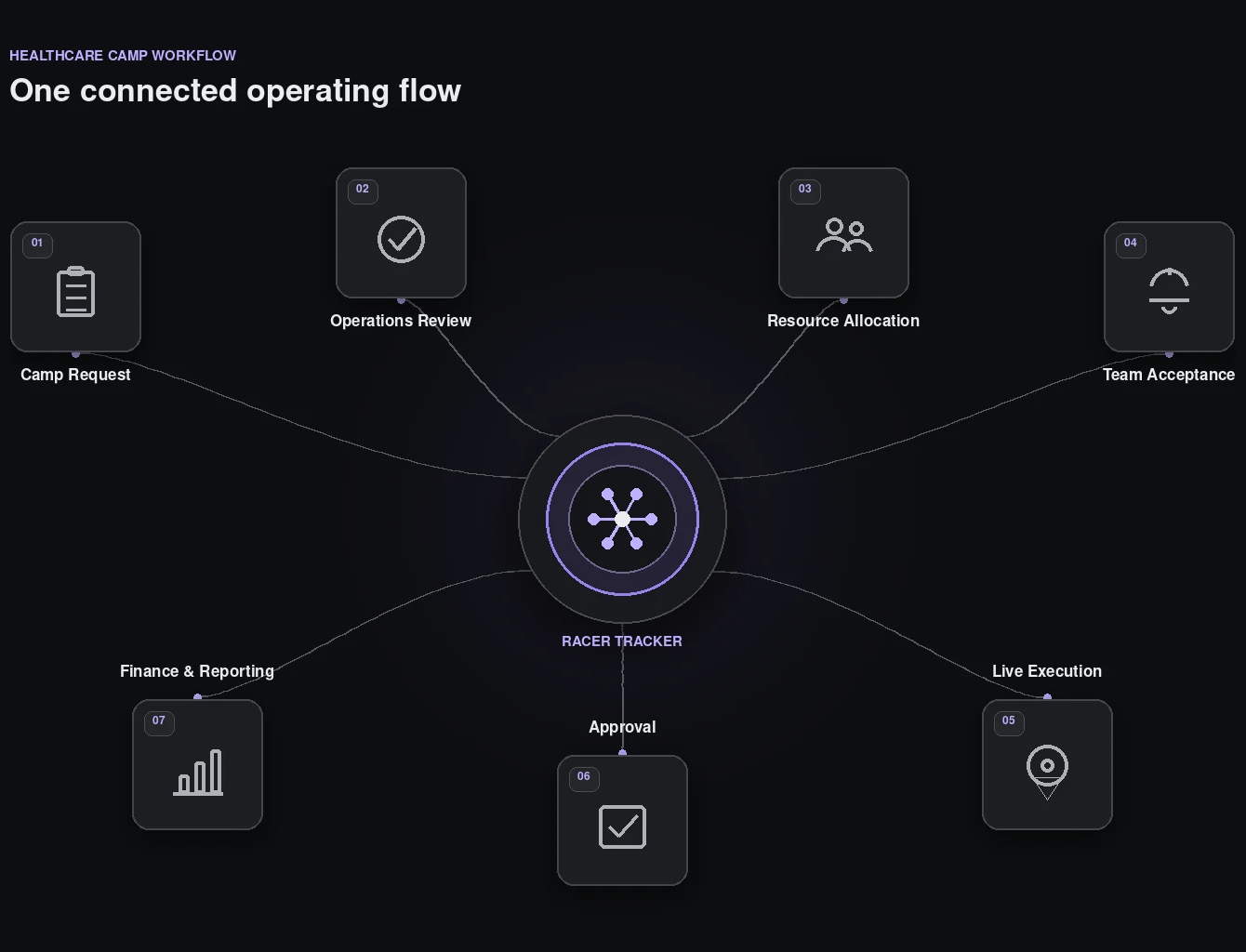
Racer Tracker followed the way healthcare camp operations actually move.
A client, MR, RSM or authorised user could raise a camp request. The system captured camp details such as location, date, time, doctor details, resource requirements and relevant documents.
The request then moved through approval and allocation workflows. Operations teams could assign coordinators, check available healthcare workers, trigger training requirements where needed and allocate the camp to a suitable field resource.
Once assigned, the healthcare worker could accept the camp, receive reminders, activate location tracking, update journey and camp timings, upload required details and submit completion information.
After execution, the coordinator could validate details, send the camp for client approval and move approved records toward finance and reporting.
Simplified Workflow
Client or Field Representative Camp Request
↓
Approval and Operations Review
↓
Resource Matching and Camp Allocation
↓
Field-Team Notification and Acceptance
↓
Live Location and Camp Execution Updates
↓
Coordinator Review and Client Approval
↓
Finance Reporting, Payment and Billing
SumCircle’s Implementation Approach
SumCircle approached the engagement by first understanding the people and processes involved in healthcare camp execution.
The work required mapping different user journeys, identifying where manual coordination was slowing the process, and translating operational dependencies into structured software workflows.
The implementation focused on:
- Mapping the complete camp lifecycle
- Defining user roles and access levels
- Structuring master data for clients, healthcare workers, devices, inventory and camps
- Creating request, approval and allocation workflows
- Integrating communication channels such as Outlook/Gmail, WhatsApp, SMS and calling
- Supporting Google/Bing Maps for location-based camp workflows
- Building dashboards for camp status, performance, billing and reporting
- Supporting KYC, training, assessment and documentation processes
- Keeping the platform practical for office teams, field teams and external users
The system was built around operational fit. Each module had to support the way camp activity was requested, assigned, executed, reviewed and reported.
Business Value Delivered
Racer Tracker helped move healthcare camp operations from scattered coordination toward a more visible, role-based and workflow-driven operating environment.
Clearer Operational Control
Teams could manage camp requests, status, assignments, inventory, reports and approvals from one connected platform.
Better Field Coordination
Healthcare workers, coordinators and operations teams had clearer visibility into assignments, camp status and required actions.
Reduced Manual Follow-Ups
Email, WhatsApp, SMS, calling and notification workflows helped reduce repetitive communication across sourcing, training, KYC, operations and camp coordination.
Stronger Resource Visibility
Teams could view resource availability, location, device allocation and inventory status more consistently.
More Structured Compliance Workflows
KYC, documentation, training and assessment flows helped keep healthcare worker onboarding more controlled and traceable.
Faster Operational Review
Dashboards and reports gave teams quicker access to camp status, executed camp history, invoices, payments and performance information.
Scalable Camp Execution
The platform created a stronger foundation for managing regular and on-demand healthcare camps as operational requirements expanded.
What This Work Shows
Healthcare camp operations sit at the intersection of people, process, location, inventory, documentation and reporting. When these activities are managed through disconnected tools, the work becomes harder to track and harder to scale.
Racer Tracker shows how a custom healthcare operations platform can connect these moving parts without reducing the project to a generic product implementation.
For SumCircle, the case study demonstrates the ability to understand a process-heavy healthcare environment and engineer software around the way the work actually happens.
Project At A Glance
| Field | Details |
|---|---|
| Industry | Healthcare Commerce / B2B Ecommerce |
| Business Area | Digital commerce for healthcare and pharmaceutical product operations |
| Services Mapped | Ecommerce Solutions, Custom Ecommerce Development, Custom Software Development, API & Systems Integration |
| Core Capability | B2B ecommerce platform, catalogue discovery, inventory workflows, order tracking, supplier and retailer management |
| Solution Type | Custom B2B commerce platform |