Thank You!
A confirmation latter has been sent to your email. Check your inbox.

 Admin
Admin
Workforce planning is no longer a static exercise. Over the last few years, organizations across industries have been forced to reassess how they access talent, build teams, and sustain delivery momentum. Traditional hiring models, once considered the backbone of organizational stability, are increasingly struggling to keep pace with rapid technological change, evolving skill requirements, and fluctuating market conditions. This is where resource augmentation has moved from being a tactical option to a strategic workforce consideration. At its core, resource augmentation allows organizations to integrate external professionals into internal teams for defined roles and durations, while retaining full operational control. Unlike outsourcing or transactional staffing, this model is designed to strengthen internal execution rather than replace it. Augmented professionals work alongside in house teams, follow internal processes, and align with the organization’s delivery and governance structures. However, Resource augmentation delivers greater value when it supports larger transformation goals like legacy system modernization, cloud migration, and AI adoption. Businesses often struggle to balance daily operations with strategic upgrades, especially when internal teams are already fully occupied. Bringing in specialised developers, cloud engineers, and system architects helps ensure faster execution without disrupting continuity. This makes augmentation not just a hiring solution, but a long-term business strategy. If you want to understand how businesses modernise core systems without slowing operations, explore our blog on Modernising Core Systems Business-First with Team Augmentation. For insights on how AI moves from simple output generation to long-term business capability, read our Gen AI to AI Capability guide
Resource augmentation is particularly effective when organizations require niche or advanced skills that are not needed on a permanent basis. These may include cloud architects, data scientists, cybersecurity specialists, DevOps engineers, or domain specific consultants. By engaging professionals who already possess these capabilities, organizations avoid lengthy onboarding and training cycles. This allows teams to focus on execution rather than capability development under pressure. Over time, this approach also supports internal knowledge transfer, strengthening long term capability without immediate hiring commitments.
Business demand is rarely linear. Growth phases, transformation initiatives, and seasonal workloads often require temporary increases in capacity. Conversely, stabilization phases may not justify maintaining expanded teams. Resource augmentation allows organizations to adjust workforce size in line with business needs. This improves cost predictability and reduces the risk of overbuilding teams during periods of uncertainty. For leadership teams, this flexibility supports more informed decision making around investment, prioritization, and risk management.
A defining feature of effective resource augmentation is integration. Augmented professionals are not treated as external vendors operating in isolation. They are embedded within internal teams, accountable to the same performance standards, and aligned with organizational objectives. Clear onboarding processes, defined responsibilities, and consistent governance ensure that augmented talent contributes meaningfully without disrupting team dynamics. This level of integration distinguishes resource augmentation from traditional outsourcing models. When executed well, the result is a blended workforce that functions cohesively while retaining flexibility.
Digital transformation initiatives often require a combination of internal domain knowledge and external technical expertise. Resource augmentation allows organizations to bring these elements together without restructuring teams or committing to long term roles prematurely. Whether modernizing legacy systems, implementing new platforms, or building digital products, organizations can supplement internal strengths with targeted expertise. This reduces execution risk while preserving strategic control.
What has changed is not just adoption, but intent. Business leaders today are not using resource augmentation to merely fill gaps. They are using it to manage uncertainty, accelerate initiatives, and build resilience into their workforce strategy. In a business environment where speed, specialization, and adaptability are increasingly decisive, resource augmentation offers a way to respond without permanently restructuring the organization. Across global and Indian markets, enterprises are facing sustained skill shortages in areas such as cloud computing, cybersecurity, data engineering, AI, and advanced product development. According to the World Economic Forum’s Future of Jobs Report, a significant share of employers expect talent availability challenges to intensify rather than ease, particularly for emerging technology roles. This mismatch between demand and supply has made traditional hiring cycles both slower and riskier. At the same time, workforce expectations have shifted. Skilled professionals increasingly value flexibility, project based work, and opportunities to apply their expertise across diverse environments. Resource augmentation sits at the intersection of these realities. It enables organizations to access specialized skills quickly while allowing professionals to engage in meaningful, outcome driven work without long term constraints. When approached with clarity and structure, resource augmentation becomes less about workforce substitution and more about workforce design.
India plays a significant role in the global resource augmentation landscape due to its large and diverse talent base, particularly in technology and engineering. Industry data shows continued growth in flexible staffing and contract based employment across Indian enterprises, driven by demand for digital skills and project based work.
This trend is reinforced by the expansion of global capability centres and increased investment in digital infrastructure. For global organizations, India represents both a source of talent and a strategic partner in scalable workforce models.

Successful resource augmentation requires intention and structure. Leaders should clearly define use cases where augmentation adds value, align it with broader workforce plans, and establish governance frameworks that ensure accountability and integration. It should complement internal hiring and upskilling initiatives rather than replace them. When treated as part of a holistic workforce strategy, resource augmentation strengthens both immediate execution and long term capability.
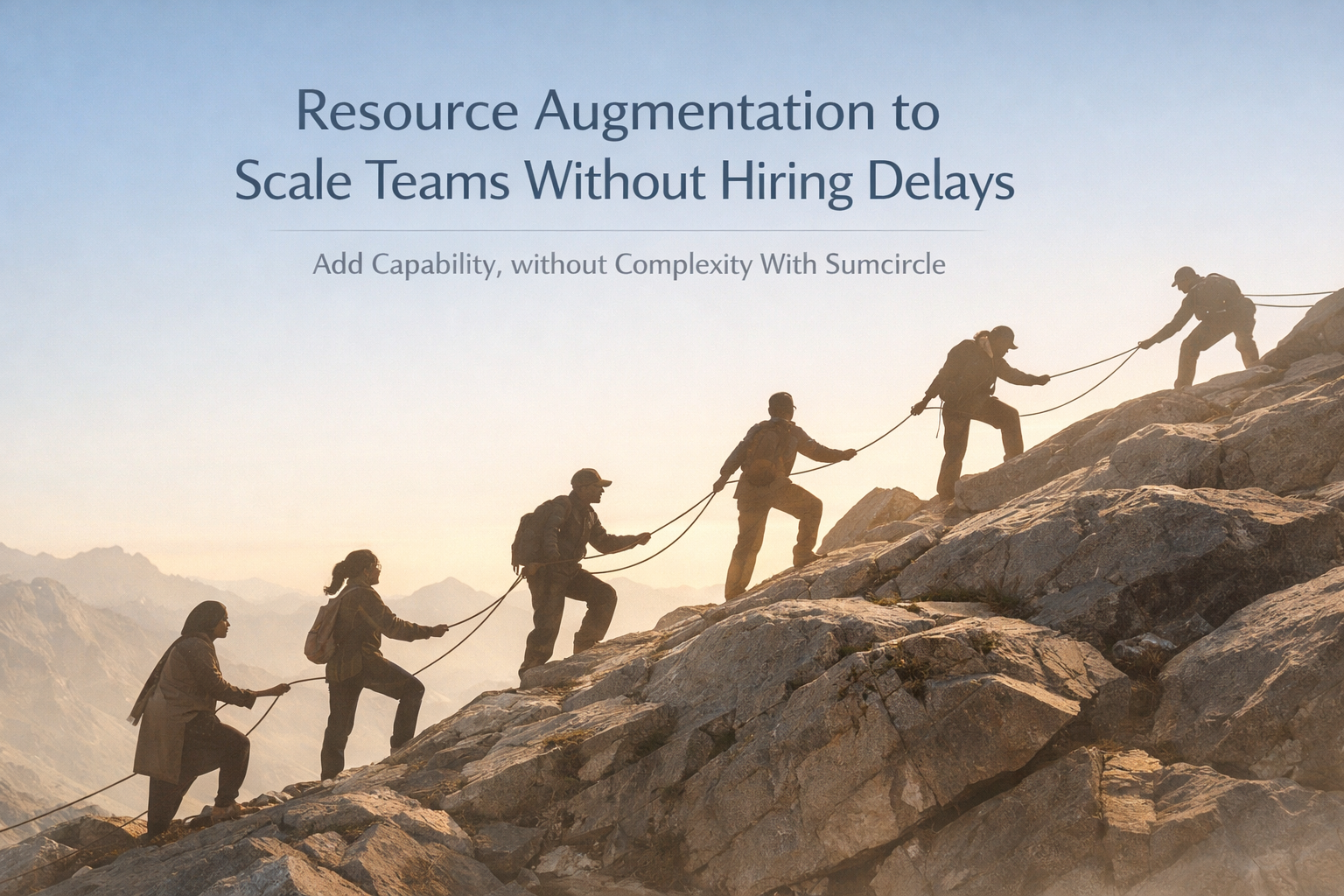
Many organizations are moving away from rigid role definitions toward skills based planning. This approach focuses on what capabilities are required to achieve specific outcomes, rather than how roles are traditionally structured. Resource augmentation fits naturally into this framework. It enables leaders to assemble teams based on required skills and experience, supporting more dynamic and responsive workforce planning.
Resource augmentation reflects a broader shift in how organizations think about work, talent, and delivery. It acknowledges that no single employment model can meet all business needs and that flexibility, when managed well, can be a source of strength rather than risk. For organizations navigating complex transformations, evolving markets, and persistent skill shortages, resource augmentation offers a way to stay responsive without compromising control. It allows leaders to design workforces that are aligned with reality rather than legacy assumptions. At Sumcircle, we work with organizations to implement resource augmentation models that are structured, transparent, and aligned with long term business goals. Our focus is on enabling teams to scale capabilities with clarity and confidence, ensuring that flexibility translates into measurable outcomes rather than operational complexity.
Our expertise spans a diverse and proven tech stack, carefully employed to build solutions that meet evolving business needs with precision and reliability.
BACK END






FRONT END










CONTAINERIZATION

AUTOMATION



CI/CD TOOLS




MONITORING

















PROGRAMMING LANGUAGES



FRAMEWORKS






LIBRARIES



CLOUD SERVICES