
Thank You!
A confirmation latter has been sent to your email. Check your inbox.

 Admin
Admin
Imagine walking into a store that remembers the colour of your last purchase, understands why you returned an item months ago, and already knows how you prefer to pay before you even reach the counter. Now imagine that experience extending seamlessly across your mobile app, website, customer support chat, email inbox, and even a voice assistant at home. This is no longer a futuristic vision. It is the practical outcome of digital transformation when it is executed with customer experience at its core. In many organisations, digital transformation still begins and ends with technology adoption. A new CRM, a chatbot, a cloud migration, or an analytics dashboard is introduced with the assumption that customer experience will automatically improve. In reality, customer experience is not shaped by isolated tools. It is shaped by how intelligently data flows across systems, how quickly an organisation can sense customer intent, and how effectively teams can respond in real time. Consumers have rapidly embraced digital behaviours. Payments, commerce, healthcare access, education, and even government services are now digital by default for millions. This has significantly shortened patience levels. Customers now expect speed, relevance, and continuity across channels. When these expectations are not met, switching costs are low and alternatives are easily accessible. Across industries, a consistent pattern is emerging. Organisations that succeed with digital transformation do not treat it as a one-time project. They treat it as a continuous capability. They invest in scalable platforms rather than temporary fixes, in strong data foundations rather than surface-level personalisation, and in automation that enhances human effort rather than replacing it. The outcome is a customer experience that feels intuitive, responsive, and dependable. This blog explores how digital transformation fundamentally reshapes the entire customer experience lifecycle. From the first interaction to long-term loyalty, it outlines the strategic pillars, practical examples, and deeper insights that help organisations move beyond buzzwords and toward measurable, experience-driven outcomes.
True omnichannel experience is not about being present on multiple platforms. It is about ensuring continuity. A customer should be able to start a journey on a website, continue it on a mobile app, and complete it through a support interaction without repeating information or losing context. Digital transformation enables this through unified customer profiles, API driven architectures, and real time data synchronisation. Every interaction becomes part of a single evolving relationship rather than a disconnected transaction.
Modern customer experience is driven by immediacy. Batch reports and historical dashboards are no longer sufficient. Organisations need real time visibility into customer behaviour, system performance, and experience bottlenecks. Streaming analytics and event driven systems allow businesses to detect issues such as payment failures, drop offs, or repeated support requests as they happen. This enables instant corrective actions that directly improve customer satisfaction.
Personalisation today goes far beyond addressing customers by name. It is about relevance, timing, and context. Digital transformation makes it possible to tailor content, offers, and experiences based on behaviour, preferences, location, and lifecycle stage. The key is balance. Over personalisation without transparency can erode trust. Successful organisations implement consent driven data usage, clear value exchange, and explainable recommendation systems that respect customer boundaries.
Automation is often misunderstood as a cost cutting exercise. In customer experience, its real value lies in removing repetitive tasks so that human teams can focus on high value, empathy driven interactions. Automated workflows for onboarding, verification, refunds, and routine queries significantly reduce response times. At the same time, complex issues are escalated to trained professionals with full customer context, leading to better outcomes and stronger relationships.
Customer experience innovation requires speed. Monolithic legacy systems slow down experimentation and limit responsiveness. Cloud native and composable architectures allow organisations to deploy new features, integrate partners, and scale experiences without disrupting core operations. This flexibility is particularly important in Indian enterprises that operate across diverse markets and regulatory environments.
Trust is an invisible but powerful component of customer experience. Secure transactions, transparent data usage, and reliable systems build confidence over time. Digital transformation initiatives must embed security, compliance, and privacy by design. When customers feel safe, they engage more deeply and remain loyal longer.
Customer experience has emerged as the primary competitive differentiator in a digitally mature market. Products can be replicated. Pricing advantages can be neutralised. Experience, however, is difficult to copy because it is built on culture, systems, and data working in harmony. Digital transformation enables organisations to understand customers at a granular level, respond to them in real time, and design journeys that reduce friction at every stage. When executed well, it shifts businesses from being reactive service providers to proactive experience orchestrators. For companies scaling across geographies, languages, and customer segments, this capability is critical. Digital platforms make it possible to personalise at scale while maintaining operational efficiency. This balance is what modern customer experience demands.
Shifting from an interface mindset to a systems mindset means moving beyond improving what customers see to reengineering how experiences are produced internally. An interface mindset focuses on visible layers such as UI design, mobile apps, chatbots, or dashboards, often treating customer experience as a presentation problem. A systems mindset, on the other hand, recognises that every customer interaction is the output of multiple interconnected systems working together in real time. From a technology standpoint, this shift requires unifying data sources through a shared customer data layer, enabling event-driven communication between services, and decoupling front-end experiences from back-end logic using APIs and microservices. It involves redesigning workflows so customer actions trigger automated responses across billing, fulfilment, support, and analytics systems simultaneously. When organisations adopt this approach, consistency, speed, and personalisation emerge naturally because the experience is engineered into the system architecture itself, not patched on at the interface level.
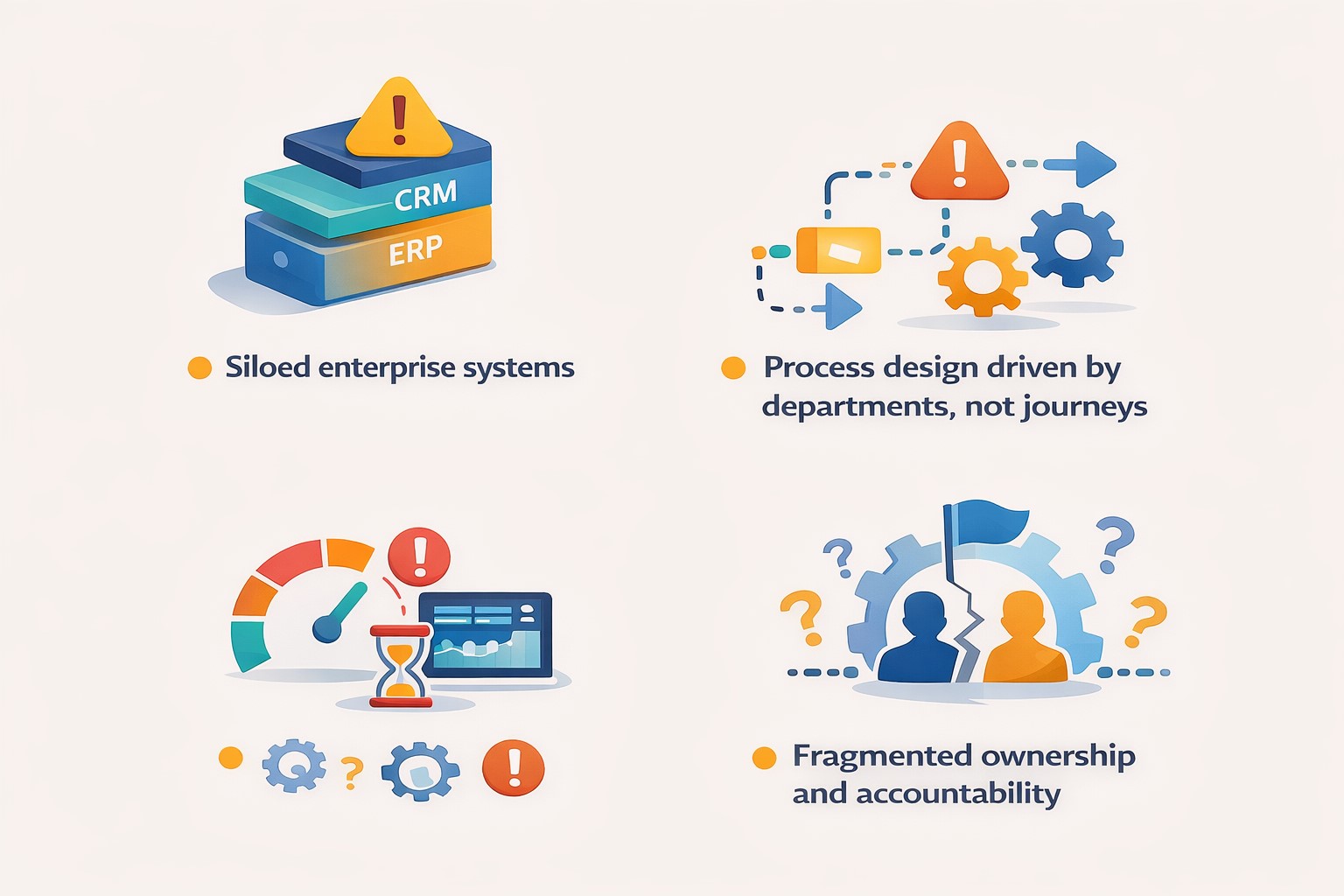
Many organisations invest heavily in modern CX tools yet struggle to see meaningful improvements in customer experience. This gap exists not because of poor intent or lack of technology, but because CX is often treated as a layer to be added rather than a system to be redesigned. Most CX initiatives begin at the interface level. Websites are refreshed, mobile apps are redesigned, chatbots are introduced, and new engagement channels are launched. While these initiatives enhance visibility and access, they rarely fix the underlying issues that shape day-to-day customer experience. At its core, customer experience is the output of internal systems working together. When those systems are fragmented, experience breaks down regardless of how polished the interface appears.

Additionally, As organisations deepen their digital transformation efforts, customer experience increasingly defines competitive advantage and long-term resilience. Independent research shows that 84 % of customers now view experience as equally important as the products or services they purchase, reflecting a fundamental shift in expectations across industries. The global market for customer experience management solutions is expanding rapidly, with forecasts projecting the segment to grow from approximately USD 12–15 billion today to over USD 60 billion by the early 2030s, at annual growth rates exceeding 10%. Collectively, these trends indicate that digital transformation investments are most impactful when aligned with seamless, data-driven, and real-time customer experiences and that organisations prioritising this alignment are better positioned to sustain relevance and trust in an increasingly experience-centric market.
Delivering seamless customer experience through digital transformation requires more than adopting new tools. It demands a deep understanding of business processes, system architecture, data flows, and user behaviour working together as one ecosystem. At Sumcircle Technologies, digital transformation is approached as an experience-first capability. Solutions are designed to connect systems, unify data, and enable real-time intelligence across the customer journey. From cloud-native platforms and API-led integrations to automation and analytics, the focus remains on building scalable foundations that support consistent, high-quality customer experiences. By aligning technology strategy with customer outcomes, Sumcircle helps organisations move from fragmented interactions to cohesive, experience-driven operations. The result is not just modern systems, but customer experiences that are resilient, adaptable, and built for long-term growth.
Our expertise spans a diverse and proven tech stack, carefully employed to build solutions that meet evolving business needs with precision and reliability.
BACK END









FRONT END










CONTAINERIZATION


AUTOMATION






CI/CD TOOLS






MONITORING
























PROGRAMMING LANGUAGES



FRAMEWORKS








LIBRARIES



CLOUD SERVICES